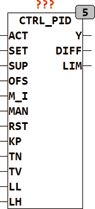
| Input ACT |
REAL (value measured by the way) |
| SET |
REAL (default) |
| SUP |
REAL (noise reduction) |
| SFO |
REAL (offset for the output) |
| M_I |
REAL (input value for manual operation) |
| MAN |
BOOL (switch to manual mode, MANUAL = TRUE) |
| RST |
BOOL (asynchronous reset input) |
| KP |
REAL (controller gain) |
| TN |
REAL (reset of the controller) |
| TV |
REAL (derivative of the controller) |
| LL |
REAL (lower output limit) |
| LH |
REAL (upper output limit) |
| Output Y |
REAL (output of the controller) |
| DIFF |
Real (deviation) |
| LIM |
BOOL (TRUE if the output has reached a limit) |
| CTRL_PID is a PID controller with dynamic anti-wind up and manual control input. The PID controller operates according to the formula |
|
|
Y = KP * (DIFF + 1/Tn * INTEG(DIFF) + TV *DERIV(DIFF)) + OFFSET |
|
where DIFF = SET_POINT - ACTUAL |
| In manual mode (manual = TRUE) is |
Y = MANUAL_IN+ OFFSET |
| ACT is the measured value for the controlled system and SET is the setpoint for the controller. The input values of LH and LL limit the output value Y. With RST, the internal integrator will always set to 0. The output LIM signals that the controller has reached the limit of LL or LH. The PID controller operates free-running and uses the trapezoidal rule to calculate with highest accuracy and optimal speed. The default values of the input parameters are predefined as follows |
KP = 1, TN = 1, TV = 1, LIMIT_L = -1000 and LIMIT_H = +1000. With the input SUP a noise reduction is set, the value on input SUP determines at which control difference, the controller turns on. With SUP is avoided that the output of the controller wobbles. The value at the input SUP should be in dimension that it suppresses the noise of the controlled system and the sensors. If the input to SUP is set to 0.1, the controller is only at deviations greater than 0.1 active. The ouput DIFF passes the measured and through a noise filter (DEAD_BAND) filtered control deviation. DIFF is normally not required in a controlled system but can be used to influence the control parameters. The input OFS is added as the last value to output, and is used to compensate mainly of noise, whose effect can be estimated on the loop. |
|
The controller works with a dynamic air- Up that prevents that the integrator, when reaching a output limit and further deviation, continues to run unlimited and affects the properties usually negative. In the introduction chapter of the control technology, more details can be found on anti-wind-up. |
| The control parameters are given in the form of KP, TN and TV, and if there are parameters KP, KI and KD they can be converted using the following formula |
|
|
TN = KP/KI und TV = KD/KP |
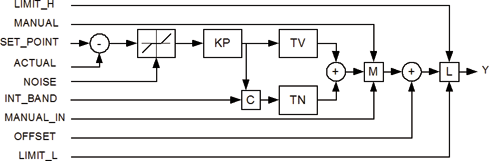
| The following graph illustrates the internal structure of the controller |
|
|
In the following example, a PID controller is shown whose SET_POINT is generated by module TUNE2 using buttons. Output DIFF is passedto a module PARSET2 which changes the parameters KP, TN, and TV depending on the deviation at the output of DIFF. |